ECOS is the name of a series of international conferences that focus on modern aspects of Thermal Sciences with particular emphasis on Thermodynamics and its applications in energy conversion systems and processes. The 38th International Conference on Efficiency, Cost, Optimization, Simulation and Environmental Impact of Energy Systems (ECOS 2025) was held from the 29th of June to the 4th of July 2025, in Paris – France.
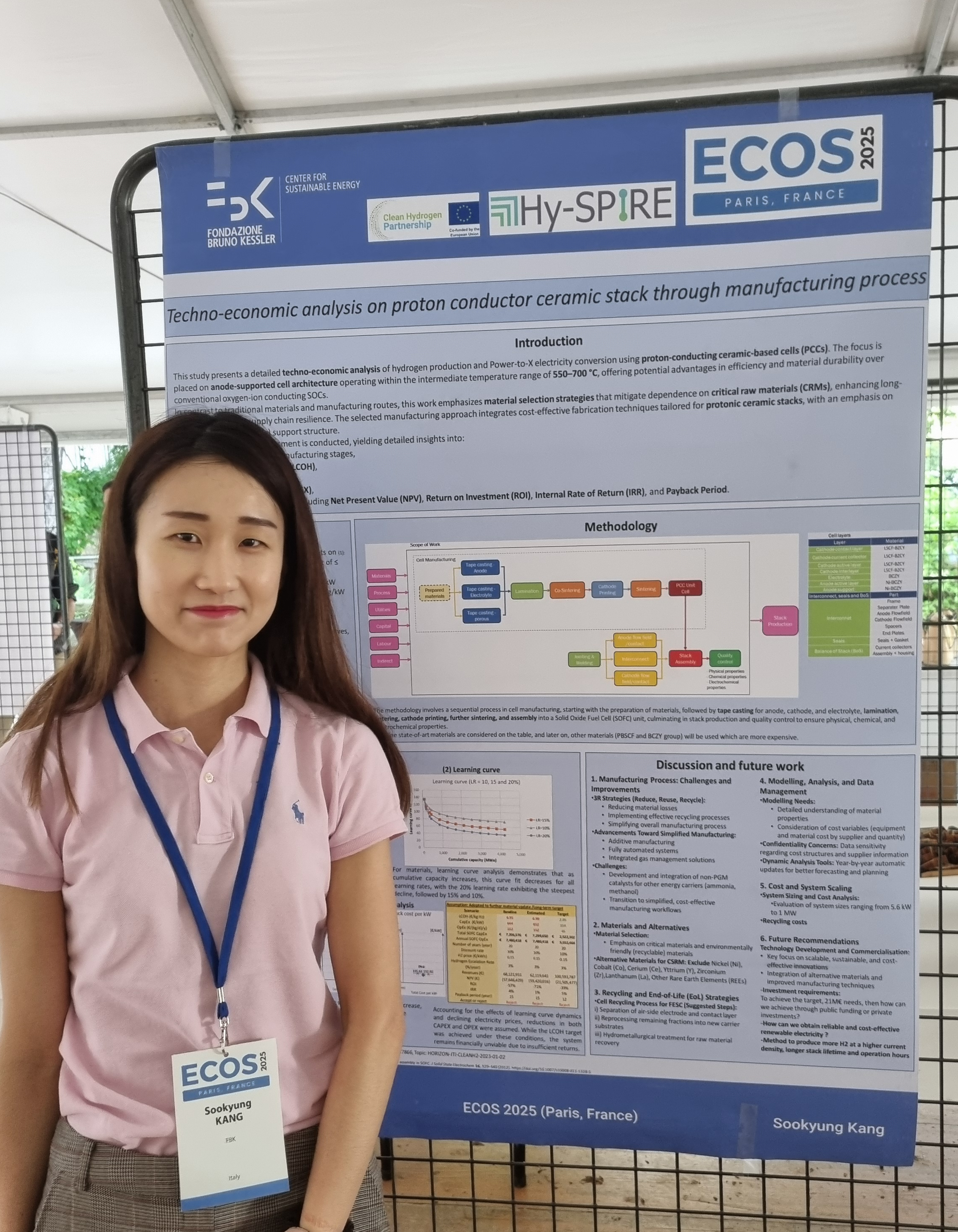
Sookyung Kang – researcher at the Center for Sustainable Energy of Fondazione Bruno Kessler – participated in the event with the poster “Techno-economic analysis on proton conductor ceramic stack through manufacturing process“.
The study presents a techno-economic analysis of an innovative solid oxide electrolyzer designed for cost-effective hydrogen production. The system aims to minimize reliance on noble raw materials while operating at intermediate temperatures (550–700 °C). By reviewing the latest advancements in solid oxide and proton-conducting ceramic electrolysis technologies, the study defines manufacturing processes, technical specifications, and material costs sourced from suppliers.
A comprehensive cost breakdown is developed for a baseline system, categorizing expenses into materials, processes, utilities, capital, labor, and indirect costs. Key economic indicators—including CAPEX, OPEX, and Levelized Cost of Hydrogen (LCOH)—are calculated, alongside future cost projections based on learning curves, system scaling, and economic performance metrics such as Net Present Value (NPV), Internal Rate of Return (IRR), Return on Investment (ROI), and payback period.
To evaluate economic viability and guide strategic development, a multi-sensitivity analysis explores the effects of key variables—green electricity price, system degradation rate, and hydrogen market dynamics—under multiple scenarios. The study benchmarks its findings against the 2030 targets set by the Strategic Research and Innovation Agenda (SRIA): LCOH ≤ €3/kg, CAPEX ≤ €520/kW, and OPEX ≤ €45/(kg/day)/year.