Blog

  • First publication for Hy-SPIRE!

    First publication for Hy-SPIRE!

    Well done to the researchers of our project partner DTU – Technical University of Denmark recently published a paper acknowledging Hy-SPIRE Project!

    The paper is entitled Development of glass sealants for proton conducting ceramic cells: materials, concepts and challenges and has been published in Open Access on the Springer Journal of Materials Science: Materials in Engineering!

    Abstract

    In this study, we have successfully developed and tested sealing concepts for symmetrical, planar proton-conducting ceramic cells (PCCCs). Three glass sealants from the field of solid oxide cells were investigated as potential compatible sealing materials for PCCCs. The most promising results were obtained with a SiO2-MgO-CaO-Na2O-Al2O3-ZrO2-B2O3 glass, which provided a dense, crack-free sealant between the proton-conducting ceramic cells and the Al2O3-coated ferritic steels. During the sealing process, a reaction layer between the interface of the BaCe0.2Zr0.7Y0.1O3-δ contained in the PCCCs and the glass–ceramic, occurred. Here, we propose a reaction mechanism for this interaction and discuss its impact on potential applications. Moreover, next to evaluating potential glass sealants, we have successfully designed and demonstrated a new sealing geometry that prevents a potential gas crossover in the symmetrical proton-conducting ceramic cell.

    Cite this article

    Georgolamprou, X., Ritucci, I., Pirou, S. et al. Development of glass sealants for proton conducting ceramic cells: materials, concepts and challenges. J Mater. Sci: Mater Eng. 19, 36 (2024). https://doi.org/10.1186/s40712-024-00184-6

    Read the article in Open Access at this link or find it on our “Results” web page: https://hy-spire.eu/results/

  • Hy-SPIRE at CMCEE14 with DTU

    Hy-SPIRE at CMCEE14 with DTU

    Last summer, from 18 to 22 August 2024, Budapest hosted the 14th International Conference on Ceramic Materials and Components for Energy and Environmental Systems (CMCEE14). 

    Wolff-Ragnar Kiebach – Head of Section Applied Ceramics and Processing at the Department of Energy Conversion and Storage of the Technical University of Denmark – presented the work entitled “Upscaling of proton conducting ceramic cells“.

    Abstract:

    Ceramics based on proton-conducting oxides are promising for a variety of applications, including fuel cells, electrolysis, hydrogen pumping, or chemical synthesis, but up-scaling of cells and stack remains a challenge. In this presentation, we will give an overview of ongoing activities at the Technical Uni[1]versity of Denmark (DTU Energy) to address this challenge. The latest results on upscaling planar proton-conducting ceramic cells (PCCs) based on Ba(Ce, Zr)O3 will be presented. Symmetrical and asymmetrical cells with an area of 140 cm2 can be produced, and the geometry and composition of the electrolyte and electrodes can varied/optimized for different applications. Also, the development of auxiliary components like interconnects and glass ceramic seal[1]ants needed to build stacks will be discussed. Furthermore, potential stacks design, which can circumvent challenges arising from the thermal expansion mismatches of the different materials used in PCC stacks, will be highlighted.

    More information on: https://akcongress.com/cmcee14/ 

  • DLR presents Hy-SPIRE at PPCC2024

    DLR presents Hy-SPIRE at PPCC2024

    Noriko Sato – Senior Researcher at the Institute of Engineering Thermodynamics at the German Aerospace Center – DLR in Stuttgart – attended the 7th International Workshop Prospects on Protonic Ceramic Cells.

    Last June 20, the researcher gave the presentation entitled “Metal Supported PCC by Scalable Techniques”.

    The work presented the MS-PCC development, including former projects and the challenges and prospects within Hy-SPIRE project.

    As reported in the website of the event, “The workshop was dedicated to new advances of solid state chemistry, material science, physical and chemical characterization, electrochemical performance and reliability, modeling and simulation, engineering and applications of solid state protonic conductor technologies.” 

    More information on the conference: https://www.ispc2.org/prospects-on-protonic-ceramic-cells/

  • First meeting for the Hy-SPIRE project

    First meeting for the Hy-SPIRE project

    The partner Technical University of Denmark – DTU hosted the first project meeting of Hy-SPIRE Project.

    On the 11th and 12th of September 2024, the Hy-SPIRE Consortium met again after several months of activities. The project launched in February 2024 had already taken several steps and laid the basis to achieve the results initially planned. 

    During the meeting, each Work Package leader presented the activities done and those planned for the next months, challenges faced and issues solved. 

    Stay tuned for other updates!

  • FBK presents Hy-SPIRE at HYCELTEC 2024

    FBK presents Hy-SPIRE at HYCELTEC 2024

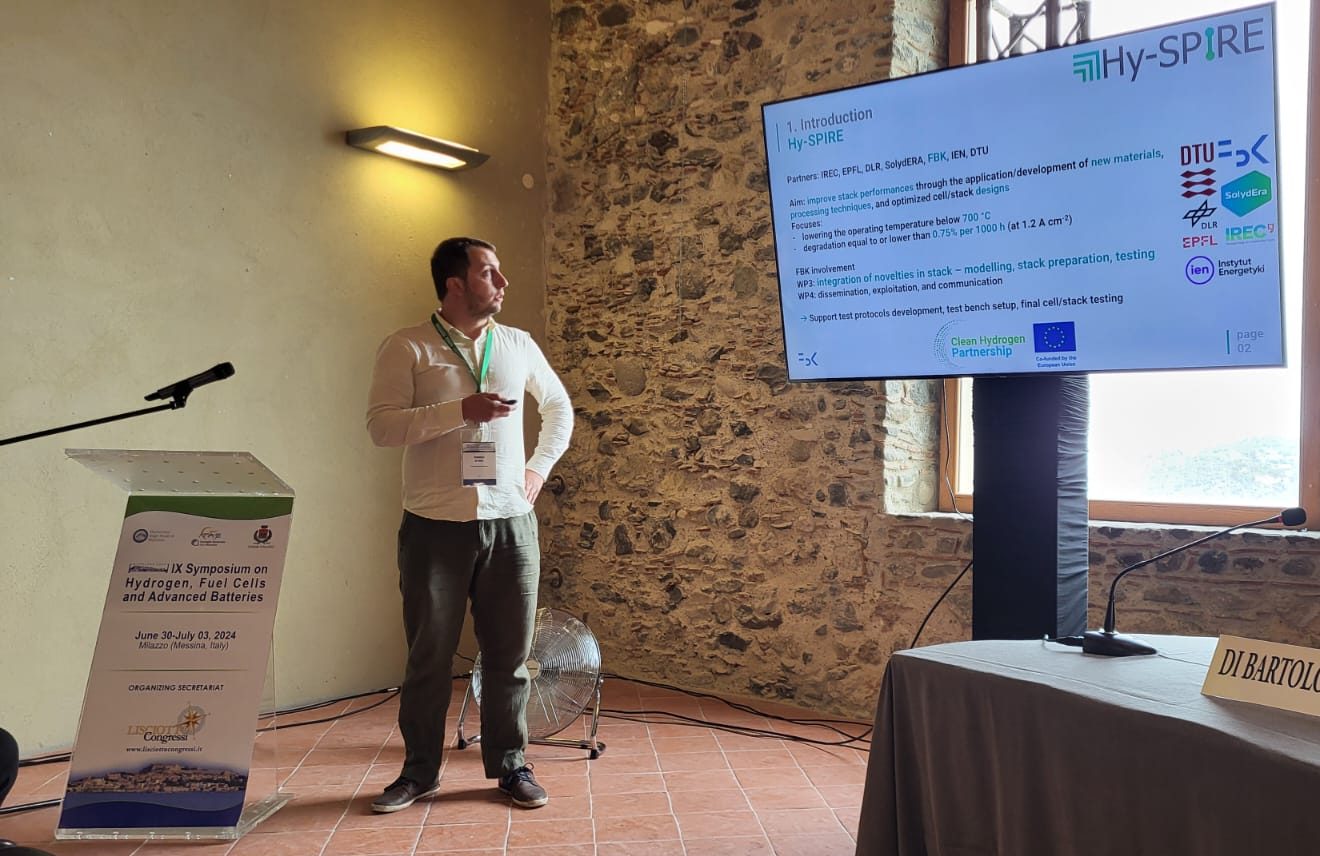
    Emanuele de Bona – researcher at the Center for Sustainable Energy at FBK – attended the IX Symposium on Hydrogen, Fuel Cells and Advanced Batteries (HYCELTEC 2024) during the first week of July 2024, in Milazzo (Sicily, Italy).

    The researcher outlined that “The conference has been a great opportunity to meet many key actors in the field of H2 production and renewable energies. The contributions were divided into 3 sessions, where the speakers shared the latest progress in their respective fields. General discussion and exchange among the different fields were fostered by the plenaries and the mixed poster session. The presence of some well known sponsors allowed also an update on their newest technologies and their possible application in the daily research work.”

    Emanuele was selected as oral contributor in the fuel cell session where he gave the presentation entitled “Symmetric electrolyte-supported solid oxide electrolyser cell for green H2 production” reported the development of the test bench for single SOECs testing in the FBK laboratories.

    The presentation was scheduled for the first day and received a good feedback both in the Q&A session and in the following coffee breaks. Overall it was very fruitful, both to update the community on the FBK activities within Hy-SPIRE, and to gather experiences and ideas from other groups facing similar challenges.

    More information on the conference: https://www.hyceltec2024.it/

  • Congratulations to our Project Coordinator!

    Congratulations to our Project Coordinator!

    Jakub Kupecki has been nominated member of the Executive Board of Hydrogen Europe Research as the External Affairs Leader during the 37th General Assembly.

    The event took place on Thursday June 13 in Budapest, hosted by the Research Center for Natural Sciences, Hungarian Academy of Sciences.

    HER brings together more than 150 research organizations and academia across Europe. Hydrogen Europe Research is a member of the Clean Hydrogen Partnership, follows and discusses European policies, works to create a hydrogen skills agenda, explores and advances the early stage development of hydrogen technologies, and shares expertise to improve hydrogen infrastructures. 

    Jakub reported that “Institute of Power Engineering – National Research Institute is one of the largest institutes in Poland and Central Europe providing research in the field of energy technologies. The Center for Hydrogen Technologies (CTH2) was established in 2020 to deliver stacks and systems with solid oxide fuel cells and solid oxide electrolyzers, accelerate the development of hydrogen technologies, support R&D activities and deployment of fuel cells and electrolyzers, provide outreach to the market and consulting services for industries. Center engages total of 60 researchers from all disciplines of engineering, including process engineering, material science, chemistry, physics, power engineering, automation and control, electrical engineering, and solid state chemistry. I’m excited to start in the new role in the Board under President Luigi Crema“.

    Photo credit: Daniel Stokowiec

    HER Linkedin post at this link

  • Hy-SPIRE presented at the event “Creating sustainable solutions thanks to the synergy of hydrogen and advanced materials”

    Hy-SPIRE presented at the event “Creating sustainable solutions thanks to the synergy of hydrogen and advanced materials”

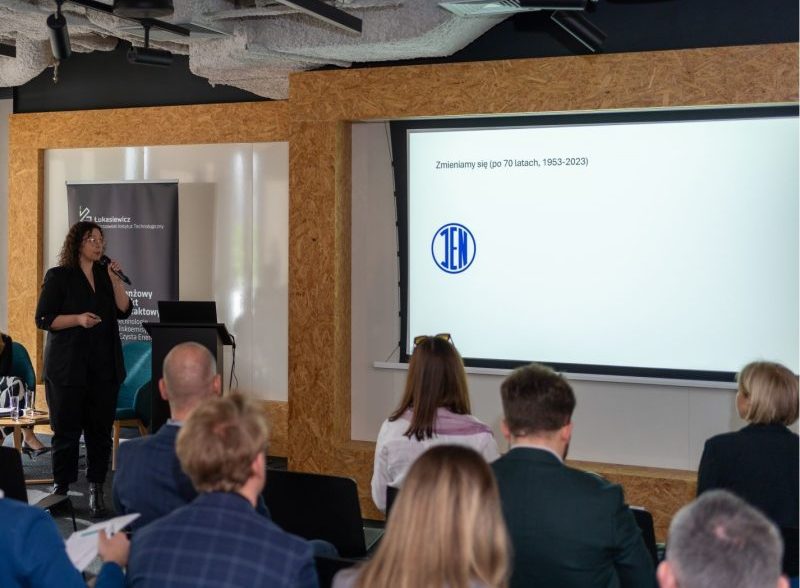
    The online meeting “Kreowanie zrównoważonych rozwiązań dzięki synergii wodoru i zaawansowanych materiałów [Creating sustainable solutions thanks to the synergy of hydrogen and advanced materials]” took place on the 10th of May 2024, from 11:00 to 12:30. As it is possible to read on the event webpage, the event was an initiative of the Silesian Nano Cluster – National Key Cluster and the Hydrogen Technology Cluster and aimed to (i) increase awareness of the potential of advanced materials for the development of hydrogen technologies, as well as (ii) creating a platform for the exchange of ideas and experiences between representatives of science, industry and administration.  Hy-SPIRE Project was mentioned by Anna Niemczyk in the IEN presentation entitled “Solid oxide electrochemical cells – technology potential and challenges in the development of the hydrogen economy”. In fact, our project is related to the development of the materials and cells and stacks. More information on: https://nanonet.pl/spotkanie-online-kreowanie-zrownowazonych-rozwiazan-dzieki-synergii-wodoru-i-zaawansowanych-materialow/ The organisers: Silesian Nano Cluster, National Key Cluster | NANONET Foundation  The NANONET Foundation is a dynamic organization whose mission is to promote and develop the nanotechnology and advanced materials industry. Since our establishment, we have been directing our activities towards building a bridge between the world of science and industry, facilitating the transfer of knowledge and technology. The Silesian Nano Cluster brings together nearly 100 entities from all over Poland – companies, scientific units, research institutes and public institutions, creating an environment conducive to the development of the industry.  Hydrogen Technology Cluster | Regional Chamber of Commerce of Pomerania  The mission of the Cluster, which inaugurated its activity in August 2017, is to initiate activities to increase the importance of hydrogen technologies and clean coal technologies by supporting Cluster members and cooperating entities in the development of innovative solutions for energy efficiency and low-emission economy.   
  • Hy-SPIRE among the success case at the Launch of the Clean Hydrogen JU Call 2024

    Hy-SPIRE among the success case at the Launch of the Clean Hydrogen JU Call 2024

    Last February 2024, the IEN researcher and Hy-SPIRE Project Manager Anna Niemczyk presented Hy-SPIRE project during the Info Day of the Clean Hydrogen Partnership.

    The Clean Hydrogen Partnership is the public-private financing program established with the aim of contributing to fostering the transition towards a clean hydrogen economy.
    The pitching session was organized by Branżowe Punkty Kontaktowe and National Contact Point for EU Research Programmes and showed how popular the topic of hydrogen technologies is in the world of science and business.

    The national event aimed to present the 2024 Call, addressed to all public and private entities interested in participating in the tender: Polish Universities, institutes and companies.

    Hy-SPIRE Project was among the success stories invited and gave IEN the possibility to share their experience in proposal preparation and to provide suggestions for submitting competitive proposals.

    More information: https://www.linkedin.com/feed/update/urn:li:activity:7168542130859040768/

  • Hy-SPIRE Project is online!

    Hy-SPIRE Project is online!

    Hy-SPIRE launches its website and social media!

    These tools will support the Consortium in disseminating the project activities and results:

    • Website: www.hy-spire-eu
    • LinkedIn: https://www.linkedin.com/company/hy-spire-project/
    • Twitter: https://x.com/HySPIREproject

    Follow us and keep yourself informed on the developments of the project!

    What’s next?

    Lots of interesting communication materials will be created and will be published among the D&C Materials section, in the Results page.

    Stay tuned!

  • Innovative Solid Oxide Electrolyzers to produce Hydrogen will be developed in the Hy-SPIRE Project

    Innovative Solid Oxide Electrolyzers to produce Hydrogen will be developed in the Hy-SPIRE Project

    The kick-off meeting of the Horizon Europe project Hy-SPIRE “Hydrogen production by innovative solid oxide cell for flexible operation at intermediate temperature” was held in Warsaw on 8-9 February 2024, hosted by coordinator – the Institute of Power Engineering – National Research Institute (IPE-NRI).

    According to long-term goals of EU, green hydrogen produced using renewable energy sources will become an energy vector for decarbonisation of the EU economy, in particular the hard-to-abate industry and transport sectors.

    Water electrolysis is the most well-known technique used for zero-emission production of hydrogen and the technology of solid oxide electrolysers (SOEL) can become a key technological advantage for EU to become a world leader in hydrogen economy.

    What is the aim of the Hy-SPIRE project?

    The overarching objective of Hy-SPIRE project is to further boost the potential of SOEL by lowering the operating temperature below 700°C and increasing its flexibility in order to match the profiles of electricity generation in renewable energy sources (RES).

    Through the development and application of new materials, advanced manufacturing techniques and optimized cell as well as compact stack designs, the project focuses on the creation of novel oxygen ion- and proton-conducting cells (O-SOE and P-SOE, respectively) on both, ceramic and metallic supports. Among the key goals of the Hy-SPIRE a low degradation equal to or lower than 0.75% per 1,000 h, operation at high current densities ca. 1.2 A/cm2 and ability to operate dynamically and fast ramping, can be listed.

    Furthermore, the technoeconomic analysis with the support of life cycle assessment (LCA) will be used for the evaluation of project novelties and the market potential, as well as the definition of barriers and research directions to achieve the objectives of the Strategic Research and Innovation Agenda. This, among others, includes the reduction of hydrogen production cost to 3 €/kg by 2030, reduction of CAPEX 520 €/(kg/kW) and OPEX 45 €/(kg/kW).

    These goals will be reached thanks to the collaboration of the consortium coordinated by the  Institute of Power Engineering – National Research Institute (Poland). The partners of the project are prominent research institutes such as Ecole Polytechnique Fédérale De Lausanne (Switzerland), German Aerospace Center (Germany), Fondazione Bruno Kessler through the Centre for Sustainable Energy (Italy),  Fundació Institut de Recerca en Energia de Catalunya a (Spain), Technical University of Denmark (Denmark), and one of the key European supplier of solid oxide cell electrolysers SolydEra (Italy).

    All of the partners have extensive experience in R&D related to SOEL, confirmed by numerous publications, patents and, most importantly, implementations. The project’s aims are ambitious, however, they will accelerate the implementation of SOEL to the market and at the same time they will position European entities as leaders in this technology” reports the Project Coordinator Jakub Kupecki. “Institute of Power Engineering – National Research Institute, beside the role of the project coordinator, will actively participate in all Work Packages. The Institute will perform comprehensive cell and stack testing, as well as will be involved in investigation of corrosion of metal-supported cell and the key stack components. Among IPE-NRI responsibilities will be the development of the testing protocols and procedure, which will be in line with European standards and other EU’s projects”.

    Fondazione Bruno Kessler, through the Center for Sustainable Energy, will lead the Work Package 4, therefore managing the activities of communication, dissemination and exploitation, and providing a techno-economic analyses supported by life cycle assessment (LCA) addressing the recycling and end-of-life scenarios for the developed technology. FBK will also be in charge of the testing of the stack and the development of dedicated protocols and procedures for the testing activity on novel SOE stack based on metal and electrode supported cells.

    The press release published by IEN (Polish): https://ien.com.pl/instytut/aktualnosci/spotkanie-inaugurujace-europejski-projekt-hy-spire;

    The press release published by IREC: https://www.irec.cat/press-society/news/towards-lowering-the-operation-temperature-of-solid-oxide-electrolysers/

    The perss release published by FBK (in Italian): https://magazine.fbk.eu/it/news/al-via-il-progetto-hy-spire-che-sviluppera-innovativi-elettrolizzatori-a-ossidi-solidi-per-la-produzione-di-idrogeno/